



 By
By The UK’s labour market dynamics are not the same as before.
Now, organisations cannot afford to leave the staffing decisions to fate. The skills gaps, automation, labour flows post-Brexit, and the pressure on the public sector have made workforce planning more significant than ever.
Whether you are studying HR, business management, or even CIPD (Chartered Institute of Personnel and Development), learning about workforce planning has become crucial for HR students.
So, in this blog, I will explain all the important things related to workforce planning for UK students. We will be reviewing various examples to help you get a better grasp of this essential concept. Let’s get started!
What Is Workforce Planning?
Let us begin with the simplest question, what is workforce planning mean?
The workforce planning is a process that follows a process of ensuring that organisations get the right people, with the right skills, in the right positions, at the right time, and at the right cost.
The CIPD UK defines workforce planning as an essential business processes that bring the alignment between workforce strategy and organisational objectives. It is not merely regarding recruitment. It entails forecasting, skills analysis, succession planning, talent management, and long-term strategic alignment.
In simple terms:
Workforce planning bridges the gap between business and people strategy.
As a student, one should know that workforce planning in HRM does not just stop at hiring. But it entails the study of the labour trends, recognising the skill shortages, and anticipating future labour requirements.
Workforce Planning in the UK Context
Workforce planning in the UK works within a unique environment, both economically and politically.
As per a report by the CIPD, the UK is facing the issue of an ageing population in its workforce planning. As around 30% of employed people in the UK are over 50. And there are not enough people to replace them when they leave the workforce.
So, it is a rising issue that the UK must consider.
UK Labour Market Trends
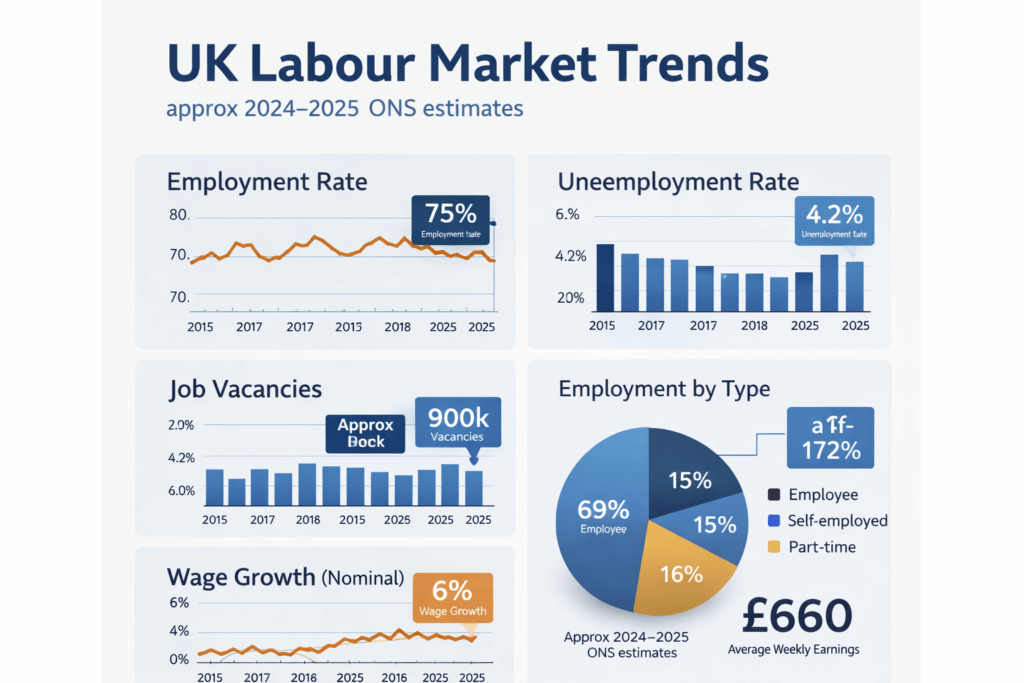
The Office for National Statistics issues regular reports on the level of employment, the level of unemployment, migration rates, and shortages in the sectors. This data is used by UK organisations in the analysis of the labour market.
Existing problems in the UK are:
- Lack of skills in health care, construction, and digital
- Greying work force in some sectors
- Changes in the supply of labour after Brexit
- Increase in automation and artificial intelligence positions.
These are the factors that have a direct impact on strategic workforce planning decisions.
Government Influence on Workforce Planning
The national policy initiatives that have a very strong influence on the workforce planning in the UK include:
- Department for Education initiatives
- Skills for Jobs White Paper
- UK Industrial Strategy
- Local Skills Improvement Plans
Such policies are meant to fill the regional skills gaps and enhance employability, especially by using apprenticeships in England and employer-led training schemes.
This makes workforce planning in the UK very closely related to public policy and economic development, as far as the students are concerned.
In the UK, the employment rate for those aged between 16 and 64 is 74.8%, which is relatively good.
Workforce Planning Definition in Academic Terms
Academically, workforce planning in the UK may be defined as:
An analytical and strategic process of predicting organisational workforce needs, evaluations of current capabilities of human capital, identification of gaps, and application of focused interventions to support the future goals.
This definition brings into focus a number of important academic concepts:
- Strategic alignment
- Forecasting and analytics
- Labour market analysis
- Skills gap identification
- Talent management
- Succession planning
Knowing these notions will make your academic writing and exam answers better.
Workforce Planning in HRM
Workforce planning is a fundamental part of Human Resource Management (HRM). It informs:
- Recruitment strategies
- Training and development
- Performance management
- Succession planning
- Employment retention guidelines
For instance, when an organisation predicts that there will be a deficit of digital skills, the HR can invest in training programmes or graduate recruitment drives at universities in the UK.
This represents the collaboration between workforce planning and development. So, basically, what is workforce planning and development? Well, it is about implementing and developing the whole plan to make it a success.
Strategic Workforce Planning
The concept of strategic workforce planning is another concept that you might come across.
What Is Strategic Workforce Planning?
Strategic workforce planning is concerned with the long-term workforce requirements (usually 3-5 years and above). It makes workforce choices in line with business strategy.
For example:
- When a company decides to go global, it has to organise language skills and cross-cultural management skills.
- When the NHS anticipates an influx of patients, it needs to predict the need for nurses and physicians.
Strategic alignment assures that the workforce planning works in line with organisational mission and goals.
A strategic workforce planning template used by many organisations entails:
- Business strategy analysis
- Workforce supply analysis
- Demand forecasting in the workforce
- Gap analysis
- Action planning
This systematic method of strategic workforce planning ensures clarity of the process with accountability.
The Workforce Planning Process (Step-by-Step)
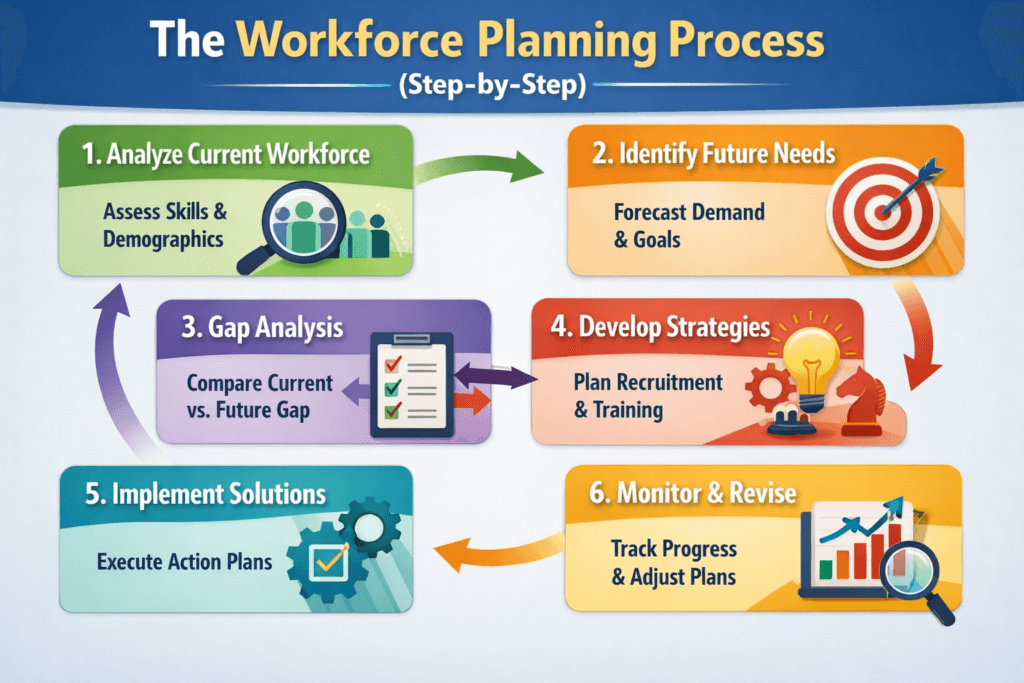
Knowledge of the workforce planning process is crucial to students.
Despite the potential differences in the models, the majority of UK frameworks comprise five essential steps.
Step 1: Organisational Strategy Analysis
Planning of the workforce starts with the review of strategic goals. You might ask questions like:
- What are the long term objectives of the organisation?
- Are there new services or technologies implemented?
- Is growth or reorganisation intended?
In the absence of this, workforce planning would have no direction.
Step 2: Evaluation of the Current Workforce Supply
This involves analysing:
- Staffing level and population
- Skills and qualifications
- Performance data
- Turnover rates
- Retirement projections
The tools employed in this stage of workforce planning include the HR analytics dashboard and internal data systems.
Step 3: Predict Future Workforce Requirement
Workforce forecasting predicts future staffing needs, which are based on:
- Market growth
- Policy changes
- Technological developments
- Labour market trends
For example, automation can decrease the number of jobs in routine positions and expand those of data analysts and AI experts.
Analytics is a pivotal part of workforce planning models as it involves forecasting.
Step 4: Identify Skills Gaps
Gap analysis compares the present workforce capacities and the future requirements.
Some of the common UK skills deficiencies are:
Organisations then make choices to:
- Recruit externally
- Upskill existing staff
- Introduce apprenticeships
- Use automation
Step 5: Develop and Implement Action Plans
This stage is all about turning your ideas into reality. It involves developing plans to deal with the crisis and implementing them. For example:
- Graduate recruitment programmes
- Apprenticeships in England
- Leadership development programmes
- Succession planning strategies
- Diversity and inclusion programs
The outcome should be monitored and reviewed to achieve continuous improvement.
Workforce Planning Examples in The UK
To understand this further, let us discuss some practical examples of Workforce Planning in the UK.
NHS Workforce Planning
The National Health Service (NHS) is among the largest employers in Europe, with a workforce of over 1.37 to 1.5 million people.
The NHS workforce planning includes:
- Forecasting patient demand
- Organising nurse and physician training
- Overcoming the local deficits
- Dealing with the ageing labour force
The migration policy and post-Brexit labour effects are considered in the NHS workforce planning because it involves international recruitment as part of healthcare staffing.
This is an excellent illustration of workforce planning in the UK within the public sector.
UK Public Sector Workforce Planning
In public sector organisations, there is a necessity to balance:
- Budget constraints
- Public accountability
- Policy changes
- Social needs
For example, localcouncils are required to design staffing needs according to the funding allocations and the needs in the community.
The public sector workforce planning in the UK usually dwells on long-term sustainability as opposed to profit maximisation.
Private Sector Workforce Planning
In contrast, the private organisations concentrate on:
- Competitive advantage
- Productivity improvement
- Innovation
- Cost control
For example, the UK technology companies might invest heavily in jobs that are associated with AI as a result of digital transformation.
This shows the differences between the workforce planning of the public and the private sectors.
Workforce Planning Models
A number of known workforce planning models have been applied in the UK. The most popular ones include:
- Supply and Demand Model
- Gap Analysis Model
- Scenario Planning Model
- 9-Box Talent Grid
- Skills-Based Planning Model
These models offer systematic methods of decision-making and forecasting.
Learners undertaking CIPD modules may be expected to critically assess these workforce planning models and Talent Management HR for success in this field.
Workforce Planning Tools
The modern workforce planning tools involve:
- HR analytics software
- Scenario planning tools
- Skills audits
- Templates of workforce planning
- The predictive modelling systems
AI-powered systems now assist with forecasting and automation planning.
This raises important academic discussions about the ethical and strategic implications of AI in HR.
Automation and AI Impact on Workforce Planning
The UK organisations are being transformed by Artificial Intelligence.
AI helps plan the workforce by:
- Automating repetitive activities
- Shifting skills requirements
- Enhancing the precision of forecasting
- Predictive analytics Support
But there is a question of job displacement, and reskilling that is also a matter of concern.
The role of AI in the planning of the workforce is becoming more significant, especially for HR students.
Workforce Planning and Employability for Students
Universities in the UK are now more focused on employability. Numerous institutions are consistent with the government initiatives, like the Department for Education reforms and regional skills plans.
Knowledge of workforce planning in the UK among students can be enhanced by:
- Career planning
- Understanding of high-demand sectors
- Strategic thinking skills
- Critical and data analysis skills
It also facilitates academic tasks in modules of HRM, business strategy, and public policy.
The advantages of Workforce Planning
Workforce planning has considerable advantages, especially in the UK context. Here are the major benefits of workforce planning:
- Reduces recruitment costs
- Improves productivity
- Minimises skills shortages
- Enhances succession planning
- Enhances talent management
- Helps in long term strategic objectives
In the case of the NHS and the public sector, it guarantees continuity of services.
In the case of private firms, it facilitates competitive performance.
Forecasting and Labour Market Analysis in the UK
The effective workforce planning process is based on the proper forecasting and analysis of the labour market. Organisational workforce data and labour market intelligence are used in the UK both internally and externally.
Internal Forecasting
Internal forecasting analyses:
- Retirement projections
- Employee turnover rates
- Promotion pipelines
- Skills inventories
- Absence and productivity information
HR analytics systems are useful in detecting trends.
For instance, when 30% of the senior managers are to retire within a period of five years, succession planning will be a very pressing issue.
External Labour Market Analysis
External analysis is the analysis of the information from the Office for National Statistics, sector skills councils, and government reports.
Key UK labour issues include:
- The employment inequalities in the region
- STEM and healthcare skills shortage
- Elaboration of post-Brexit migration trends
- Growth in green economy jobs
The awareness of these trends enables organisations to make sound workforce projections.
To students, it underscores the fact that workforce planning in the UK is based on evidence and data.
Skills Gap Identification in the UK
Skills gap identification is one of the key objectives of workforce planning.
The skills gap arises where the current employees lack the skills needed to achieve the future organisational objectives.
Government policies in the UK, including the Skills for Jobs White Paper, focus on training led by employers to decrease the disconnect between education and employment.
Examples of skills gaps in the UK are:
- Digital transformation skills
- Green energy engineering
- Advanced manufacturing
- Healthcare professionals
Organisations respond through:
- Apprenticeships in England
- Graduate recruitment
- In-house training programmes
- Partnering with universities in the UK
This shows the relationship between education policy and employment outcomes through workforce planning.
Workforce Planning Template (Student-Friendly Version)
Learners find it hard to imagine the organisation of workforce planning. A simplified workforce planning template that may be used in academic assignments is shown below.
Step 1: Strategic Review
- What are its objectives as an organisation?
- What are the external forces that affect workforce requirements?
Step 2: Existing Workforce Analysis
- Number of employees
- Skills profile
- Age distribution
- Turnover rates
Step 3: Future Demand of Workforce
- Projected growth or decline
- Technological changes
- Policy impacts
Step 4: Gap Analysis
- Skills shortages
- Weaknesses in the leadership pipeline.
- Diversity considerations
Step 5: Action Plan
- Recruitment strategies
- Training programmes
- Succession planning
- Automation integration
Step 6: Monitoring & Evaluation
- KPIs
- Productivity measures
- Review cycles
This model is similar to popular workforce planning models applied in organisations in the UK and suggested by the CIPD.
Strategic Workforce Planning Template (Advanced Version)
In the case of post-graduates or CIPD trainees, a more comprehensive strategic workforce planning template can involve:
- Environmental scan (PESTLE analysis in the UK setting)
- Labour market benchmarking
- Segmentation of the workforce (critical positions versus support positions)
- Scenario modelling (best-case or worst-case)
- Risk assessment
- Cost modelling
- Diversity and inclusion measures
This systematic framework promotes sustainability and resiliency on a long-term basis.
Workforce Planning in the UK Public Sector
The UK organisations in the public sector have a number of differences in workforce planning from those in the private sector. Let us take a look at them:
Public Sector Characteristics
- Existence of strict regulation
- Budget constraints
- Political accountability
- Service delivery focus
One of the most visible examples is the National Health Service.
NHS Workforce Planning in the UK Example
The NHS must forecast:
- Patient population growth
- Ageing demographics
- Regional staffing needs
- Doctor and nurse training pipeline
It collaborates with education providers and government departments to maintain workforce sustainability.
This explains the role of workforce planning in the UK in supporting national health concerns.
Workforce Planning and Apprenticeships in England
In England, apprenticeship is a significant part of developing the workforce. They match the requirements of employers to educational provision.
The Department for Education manages the policy of apprenticeships and facilitates strategic workforce planning through:
- Handling shortages in the sector
- Fostering professional routes
- Improving employability
To students, this shows the effect of workforce planning on the national skills policy.
Public vs Private Sector Differences
It is significant to understand the differences between the public and the private sectors on an academic level.
| Public Sector | Private Sector |
|---|---|
| Concentrate on service delivery | Concentrate on profit and competitiveness |
| Financial limitations | Growth through the market |
| Policy-based staffing | Strategy-based staffing |
| High accountability | Shareholder accountability |
Both are based on workforce planning, although the priorities are different.
Automation and AI in UK Workforce Planning
AI is changing the way organisations are forecasting their workforce.
AI assists workforce planning tools through:
- Predicting turnover risk
- Analysing skills trends
- Workforce scenario modelling
- Determining the patterns of performances
Nevertheless, automation also applies to job positions. Replacement of some tasks is accompanied by the emergence of new positions.
Digital transformation policies in the UK are associated with the UK Industrial Strategy, which promotes innovation in the country and leads to reskilling the workforce.
Therefore, the students are required to evaluate critically:
- Ethical implications
- Job displacement risks
- Needs of transformation of skills
Challenges in the UK Workforce Planning
The workforce planning in the UK has many challenges that include:
Post-Brexit Labour Impact
Hospitality, healthcare, and agricultural sectors are some of the areas that have been impacted by reduced EU migration.
Skills Shortages
Continuous engineering and digital insufficiencies inhibit development.
Data Limitations
Data on the workforce may not be complete, thereby lowering accuracy in forecasting.
Rapid Technological Change
AI and automation need to be constantly adapted.
Ageing Workforce
Retirement waves are experienced in the public sector organisations.
So, the recognition of such challenges in workforce planning in the UK can help strengthen the analysis.
Workforce Planning For Students: Why It Matters
To undergraduate students and postgraduate students, workforce planning has several advantages:
- Enhances strategic thinking
- Enhances employment knowledge
- Supports dissertation research projects
- Enhances the quality of assignments at CIPD
The UK has many universities that are modifying their curricula in line with regional skills priorities that are being informed by programs like the Local Skills Improvement Plans.
This demonstrates the fact that work planning is not only organisational but also has impacts on the development of the nation.
Frequently Asked Questions
What is the goal of workforce planning?
The goal of workforce planning is to make sure that organisations get the right people at the right time and with the right skills to achieve strategic goals.
What are the steps in workforce planning?
The general steps in workforce planning in the UK include: strategic investigation, workforce evaluation, projection, gap study, action planning, and tracking.
How does workforce planning improve productivity?
It eliminates skills gaps, enhances role fit, and maintains optimal levels of staffing.
What is meant by workforce planning?
It is the prediction of the supply and demand of the workforce to address the future organisational needs.
What are workforce planning techniques?
Some of the techniques are scenario planning, skills audit, gap analysis, HR analytics, and workforce forecasting.
How does CIPD define workforce planning in the UK?
The CIPD defines it as an essential business process that coordinates people strategy and organisational strategy.
Why is workforce planning important in the UK?
It is important in the UK due to skills shortages, ageing workforces, post-Brexit labour shifts, and technological revolution.
What is strategic workforce planning?
It involves long-term workforce planning in the UK that is in line with business strategy and is normally a period of 3-5 years or longer.
What are workforce planning models?
These models are the supply-demand models, scenario planning, gap analysis models, and the skills-based planning frameworks.
What is workforce forecasting?
It is the forecast of future workforce demand regarding the information and strategy.
Final Words
In a nutshell, Workforce planning in the UK is much more than a recruitment exercise. It is a strategic and data-driven process, which fits organisational goals and people capabilities.
From the NHS to individual technology companies, and from government policy to university employability policy, workforce planning is making a key contribution to national economic development.
In the case of HR and business students, understanding the principles of strategic workforce planning, workforce forecasting, skills gap analysis, and public sector workforce planning in the UK will be a good background in terms of academic and professional foundations.
Knowledge of workforce planning is not just a simple skill required in exams and CIPD courses- it is also a crucial skill in defining the future of work in the United Kingdom.



