


 By
By If you have to complete your CIPD assignment on time, then you must consider the instructions and guidelines in the assignment brief. However, the instruction that you must not ignore at all costs is the CIPD word count policy. This requirement is non-negotiable and can cost you grades if you don’t follow it.
Some students are not aware of it, while others are aware and ask questions like what happens if they go beyond the required word count or submit something shorter than required.
Moreover, if you need to know about the CIPD word count policy in detail, then don’t worry. Just keep reading this blog so you don’t mess up with the word count and be successful in your submission
Understanding the CIPD word count policy 2025
If you want to succeed in your CIPD journey, then you must follow the instructions regarding the CIPD level 3 word count requirements, CIPD level 5 assignment word count, and CIPD level 7 word count rules.
Whether you are enrolled in CIPD level 3, 5, or 7, CIPD sets the word count for every assignment you have to complete. Moreover, these word limits are not random; they aim to help students with concise and focused writing, ensure fair assessment across the CIPD learners, and evaluate your ability to communicate in a clear and precise way.
When you go through the assignment brief, you will notice a recommended word count. Moreover, going beyond that word count or falling short can affect your grades.
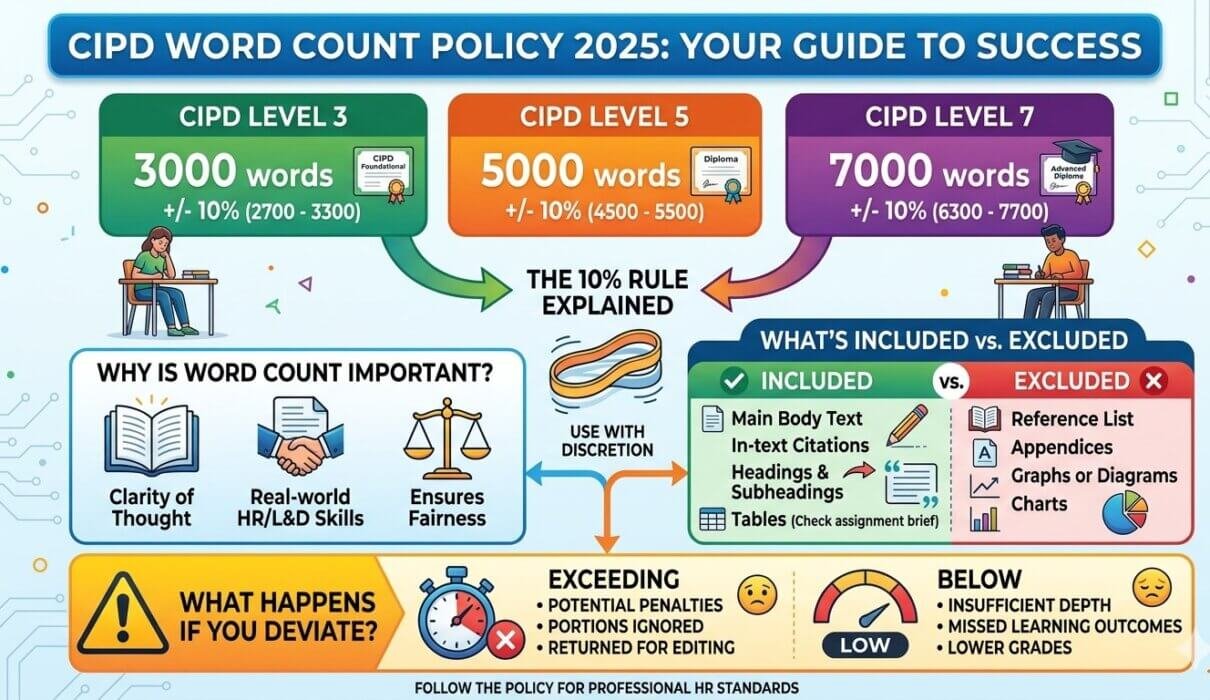
CIPD word count policy level 3:3000 words +/-10%
CIPD word count policy level 5: 5000 words +/- 10%
CIPD word count policy level 7:7000 words +/- 10%
What is the 10% Rule in the CIPD word count policy?
Note that CIPD offers an acceptable tolerance range that is around +/-10% of the required word count.
For example, if the word count is 3000 words, then the acceptable range is a minimum of 2700 words and a maximum of 3300 words without penalty. Moreover, if you follow this range, your work will reflect academic and professional standards.
Moreover, they have provided flexibility themselves because they are aware that following the exact word count can be a bit impossible. Therefore, this 10% rule can provide the flexibility to follow the word count naturally without having to be stressed about it.
However, at first, you must try to follow the exact wordcount and if you feel you cannot cover the content within that limit, then only you can take advantage of the 10% rule.
(It’s conditional, and you must not do it in all submissions.)
Why is the CIPD word count policy more important than you think?
To be successful in your CIPD journey, you must not consider the word count as a formality, as word count reflects key professional skills. The CIPD aims to prepare you for HR and L&D roles. In such a role, effective communication is essential.
- Clarity of thought: if you can explain a concept within a word limit, it shows that you have understood the concept very well.
- Reflects the real-world skills: in the HR and L&D roles, you will have to craft reports and briefings in which you will have to follow strict word counts.
- Ensures fairness: the CIPD wordcount policy also ensures fairness as each CIPD learner is assessed on equal terms.
What counts in the CIPD wordcount policy?
You must understand what’s included in the word count so that you can plan your content accordingly.
CIPD word count policy typically includes main body text, in-text citation, headings, subheadings, and text in tables of your assignment(it may also be excluded)
Moreover, what is not included in the word count policy is the reference list, appendices, graphs or diagrams.
These instructions may vary, therefore always go through your assignment brief meticulously.
What will happen if you exceed the word count limit in the CIPD assignments?
If you are thinking, does CIPD allow extra words in assignments? Then let me tell you that exceeding the CIPD workout policy may seem harmless, that you are just adding more information, and some students might think that it may be an advantage. However, you will have to face negative consequences.
Potential penalties
Some examiners will only accept the 10% rule, and any word beyond that will be ignored. It means that your extra content won’t be marked. For example, if you have started your conclusion after completing the wordcount then it will be ignored, costing you marks.
Returned for editing
Some examiners may return your work so that you can edit it. It will delay your result.
Poor impression
Exceeding the word count shows that you haven’t understood the concept or you don’t know how to prioritise the information.
Academic misconduct
Some examiners may consider exceeding the word limit as academic misconduct.
What happens if you write below the word count limit in the CIPD assignments?
If you write your CIPD assignment below the required word count, then be ready to face the consequences.
Insufficient depth
A lower word count shows that you haven’t understood the topic in depth, and your response lacks analysis, examples, or critical evaluation.
Missed learning outcomes
Each CIPD assignment has a specific learning outcome. Moreover, a shorter repose shows that you haven’t addressed the learning outcomes.
Lower grades
No matter how professionally you have crafted your assignment, if it lacks details and examples, then your grades will suffer.
| Are you struggling to craft your CIPD assignments?
Then don’t worry and let our writers do the task for you. Whether you need guidance to understand a complex topic or need help with an assignment from scratch, we are always available. Let’s connect! |
How to write your assignment within the CIPD wordcount policy?
Here are some academic writing word limit tips.
1. Plan before you write
You must start with an organised structure including an introduction, body, and conclusion. Moreover, allocate word count to each section so that you can stay on track.
2. Focus on the assessment criteria
CIPD assignments are based on specific criteria. Moreover, make sure that your assignments address that criterion.
- Don’t add irrelevant information.
- Don’t overexplain the concept.
- Don’t repeat the phrases and words.
3. Be concise and precise
In your CIPD assignment, you must use professional language and avoid the use of filler or complex words.
4. Use word count tools
Use a wordcount tool that updates the count as you work, so that you are aware of it naturally and as you write.
5. Use evidence wisely
In your assignment, you should add relevant examples, case studies, and theories. However, don’t overload your assignment with a lot of references.
6. Edit your work
Once you have completed your assignment, remove the repetitive phrases, unnecessary words, and simplify the phrases.
If your word count is under the limit, then add more examples, expand your analysis, and critical evaluation.
Key tip: Verify your word count before submission.
All in all!
The CIPD word count policy is really crucial, and you shouldn’t ignore it if you want success in your academic journey. Just make sure that you follow the 10% rule and also allocate the word count for each section before you rush to the writing.
Moreover, this policy is more like a framework that helps you develop skills like clarity, effective communication, etc. The key tip is to focus on relevance and avoid redundancy.
Frequently Asked Questions
What is the CIPD word count policy?
The CIPD word count policy is 3,000 words for Level 3, 5,000 for Level 5, and 7,000 for Level 7; also it includes the +/- 10% tolerance on the required word count.
Why is the CIPD word count policy important?
CIPD word count policy is important for conciseness, effective communication, and fairness.
Is it acceptable to exceed the word count in a CIPD assignment?
It is not acceptable to exceed the word limit in a CIPD assignment. However a leeway of +/- 10% is usually allowed.
Is it acceptable to write below the word count in a CIPD assignment?
It is generally acceptable to write below the CIPD word count within a 10% margin.
How to follow the wordcount policy in the CIPD assignments?
The main tip to follow the CIPD wordcount policy is to plan your word allocation.
What is the 10% rule in the CIPD?
The 10% rule in the CIPD allows students +/- 10% tolerance on the total word count for their assignments.
What is the CIPD level 7 word count rule?
The CIPD level 7 word count rule is 7,000 words (+/- 10%).
Does CIPD allow extra words in assignments?
No, CIPD doesn’t allow extra words in the assignments. It only allows for a deviation of up to 10%.
What are the assignment word count rules in the UK?
In the UK, you have to adhere to a specified limit, with a permitted 10% tolerance (over or under).
What are some academic writing word limit tips?
Two important tips for following the word limits are: Plan Word Allocation and Eliminate Redundant Phrases.



